

While cultures tend to grow organically in organizations, it is leadership behaviors that drive the culture. These behaviors dictate the kind of actions that are acceptable or even possible within the company. More positive leadership behaviors will expand or enhance performance, while the more negative leadership behaviors often restrict or inhibit performance. Yet when looking to instill new values or employee behaviors across the organization, leaders often forget about the culture they helped put in place through their actions.
I have worked with a number of organizations that have recently adopted new values statements or identified a core set of employee behaviors that they want to promote. These values and employee behaviors aren’t new to the organization. Rather, leaders want team members to apply them more consistently and deliberately, as a way of standardizing or enhancing performance.
There is typically a formal launch to the process. There may be some training, and other systems and processes put in place to support the values/employee behaviors. This will be accompanied by discussions on how leaders will hold their team members accountable for the values/employee behaviors.
Those actions will often have a strong initial impact and generate some real momentum for the effort. But they cannot guarantee widespread adoption, at least not at a significantly higher level than existed before the initiative was launched.
One factor that is often missing from the discussions is culture. In every organization, there will be elements of the culture that refinforce the desired values/employee behaviors, and those that limit or even discourage their adoption. By defining and leveraging the more supportive traits, and identifying and addressing the more disruptive traits, leaders will be in a much better position to enable adoption of the values/behaviors at scale.
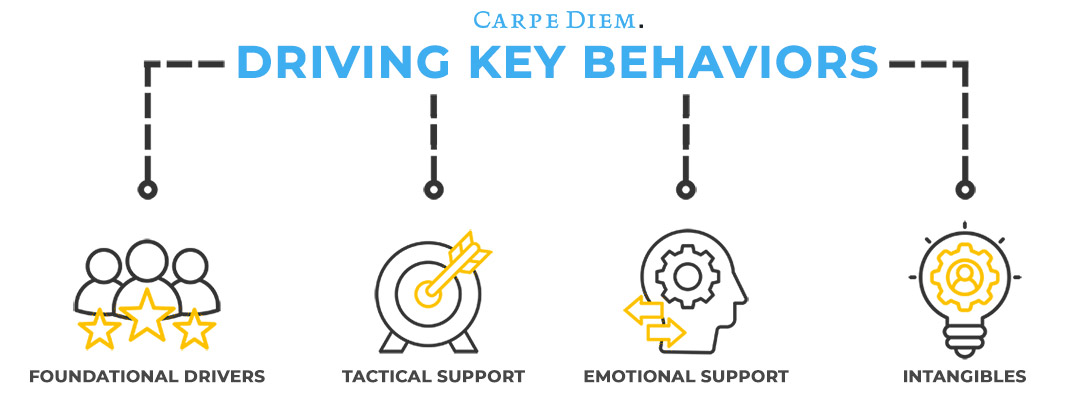
These cultural traits fall into one of four categories:
- Foundational Drivers – These are elements of the culture that aren’t tied directly to the desired values/employee behaviors but are part of the culture at large. They create the kind of broad-based working environment in which the values/employee behaviors can thrive.
- Tactical Support – These are the operational norms that exist in organizations to support the employee behaviors. They may be the product of formal systems and processes, or they may be norms that developed organically over time.
- Emotional Support – These are the factors that give team members the license and courage to act, particularly when the desired values/employee behaviors add more to their plates or otherwise pull them out of their comfort zone.
- Intangibles – These additional elements of the culture aren’t necessarily ‘must have’s’ for adoption. But they can push team members over the edge towards adoption, often by reinforcing the foundational, tactical, or emotional support components.
* * *
Let’s consider an example. A value/employee behavior that leaders often stress is collaboration. In the context of these values exercises, collaboration is about actively seeking out others in one’s own department or another department and producing results as a group that are better than what the individuals can achieve independently.
Foundational Drivers
There are a number of cultural factors that will drive or discourage collaboration. From a foundational standpoint, it helps to have people who share a common sense of purpose that is outlined and modeled by leadership – not just about the current assignment but around the organization’s broader objectives. This draws people together and makes them more likely to want to interact. The sense of purpose also acts as a universal translator of sorts, as everything about the project or assignment can be processed through that lens.
A second foundational driver of collaboration is open and honest communication, starting from the top down. Again, this is not limited to the project at hand. Collaboration is more likely where there is a history of transparency across the organization. In more guarded or distrustful organizations, people may be hesitant to reach out to co-workers or to share the kind of information needed to make collaboration effective.
Tactical Support
While the foundational drivers provide the motivation to collaborate, people still need the ability to collaborate. There are some very practical considerations here, particularly when working with colleagues outside of one’s function or department. People have to know who the experts are in other parts of the organization. It is also easier if they have direct access to those experts, rather than having to “go through channels” to reach out.
Leaders also have to provide staff members with the mechanisms to collaborate. Organizations have made significant investments in tools and platforms to facilitate collaboration. Yet not everyone is as adept in using those tools, nor is there consistently accountability in organizations around their use.
Some organizations will take the additional step of forming cross-functional teams to work on a particular opportunity or challenge. As with the platforms, the efficacy of these teams can vary, depending on how clearly the organization defines the scope of the work, the division of responsibilities among team members, and whether the team is truly empowered to work on the problem.
Emotional Support
Even if the organization lays the groundwork for collaboration, employees have to be willing to take that leap of faith. This is not as clear a choice as it seems.
Some employees want “permission” from their leaders or managers to collaborate. After all, it takes time to collaborate – to set up the effort, to check-in with partners, to reach consensus on the different deliverables and outcomes. This can take people away from some of their day-to-day activities.
Additionally, participants in the process may feel a loss of control over the work. Hence, they are looking for that reassurance that their leaders and managers are on board. Leaders and managers can demonstrate their approval by consistently highlighting the importance of collaboration, calling out different opportunities to collaborate, and checking in with team members during the course of their collaboration efforts.
Collaboration also requires trust – not just at the organizational level, but within and across functions. People can have different responsibilities, timelines and incentives that can pull them in different directions. There is also a “grass is greener” mentality that can take hold in organizations, where one group feels like they aren’t getting the same treatment or receiving the same perks and benefits as others. A first step towards collaboration then may be for leaders to create or enhance dialogue and education across functions, addressing some of the perceptions and misperceptions that are keeping people apart.
Intangibles
Beyond having trust in their co-workers, employees need to have trust in the system. Effective collaboration will serve the needs of both the company and its customers. But for any action out of the ordinary, employees will also consider their own risk and reward.
A reality of office politics is that people don’t always get their share of the credit/recognition for success, nor are they held equally accountable when things go wrong. This concern will be more prevalent in certain organizations than others.
Some teams will have charters or use RACI charts to clarify roles and responsibilities. In sales situations, there may be a defined process for distributing the sales credit and resulting commissions. Most of the time this is done informally, with recognition and accountability left to the interpretation of individual leaders and managers.
In these situations, trust is easier to come by if there is a general sense of fairness in the organization around performance. Evidence of this might include: 1) clear accountabilities for performance, reinforced by a rigorous performance management system; and 2) a commitment to timely and constructive feedback and recognition to employees.
Employees may also consider whether there are some meaningful benefits for excellence in performance. There is going to be a greater impetus to stretch in one’s role if it puts the employee on a different bonus track or if it advances their opportunities for growth and promotion.
These intangible factors are not necessarily going to be the make or break on the decision to collaborate. However, they can impact the extent to which team members seek out opportunities to collaborate and their level of enthusiasm for the process.

These market insights from Carpe Diem Global Partners are gathered from the firm’s extensive client work with Board, CEO, CXO, and CHRO leaders in public and private multinational companies. For deeper, custom insights, contact Craig Kamins at ckamins@carpediempartners.com.