How Leaders Can Drive Emotional Empowerment

Most employees have an innate desire to contribute and achieve, even in more challenging times. Their ability to do so will be driven in part by their own talents, commitment, and initiative. But they will also need help from their leaders to drive certain actions and to navigate the various structural and cultural barriers that might be inhibiting their success.
The Three Levels of Empowerment
Empowerment occurs at three levels, forming a pyramid of empowerment, with each level addressing a different set of employee needs and requirements.
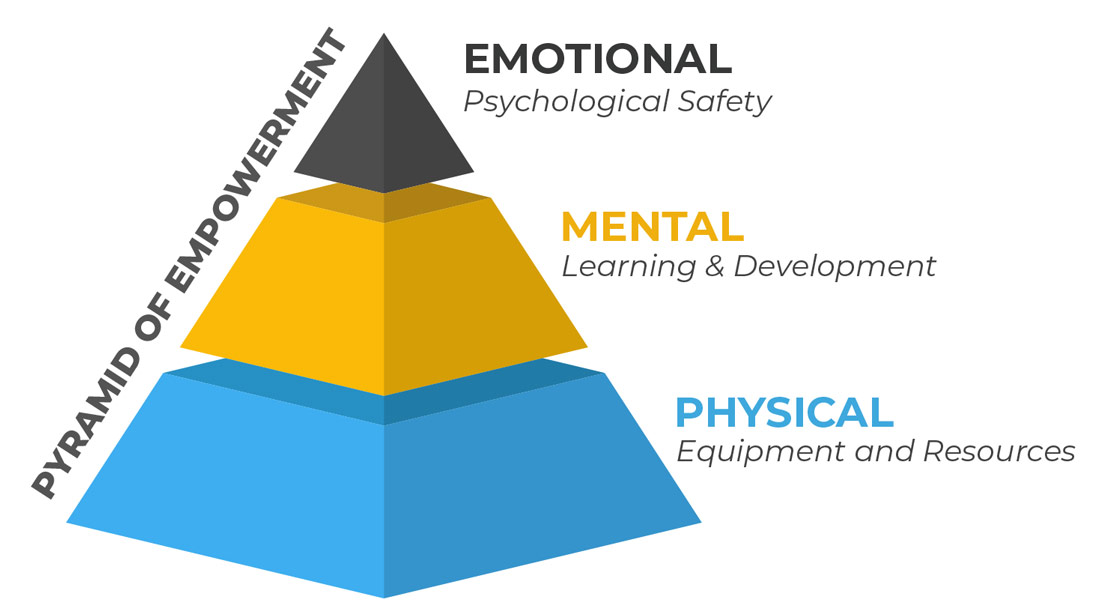
At the foundational level, leaders can help ensure teams are adequately resourced. These more tangible forms of support serve as the basic building blocks of performance and represent the physical aspect of empowerment.
A second level of empowerment comes from training and development. Here people are learning about different aspects of their job or adding to their overall range of skills. This is then reinforced on the ground through coaching and feedback. We can call this the mental aspect of empowerment.
The highest level of empowerment comes from having the freedom to act. Some of this is a function of structure and process, where employees are put in a position to succeed. It is also about eliminating fear from the job, creating a sense of psychological safety. This then is the emotional aspect of empowerment.
The Unique Importance of Emotional Empowerment
Employees need support from leadership at all three levels to feel truly empowered.
- Employees that lack sufficient resources, are working with outdated technology, or are struggling through staffing shortages, may feel ineffective or overworked in their role.
- Those lacking meaningful training or development opportunities, or receiving limited feedback on their work, may feel unprepared or ineffectual.
- In situations where there is no psychological safety, employees are likely to feel restricted or controlled.
As with any pyramid, the ideal scenario would be to build up from the base – ensuring that employees are fully equipped (physically empowered), then trained on how to leverage those tools (mentally empowered), then given the freedom to exercise those newfound capabilities (emotionally empowered). One wrinkle in that scenario is cost.
There can be considerable outlays required for tools, staffing, and training. While I would always advise clients to invest in their people, that simply may not be in the budget for a lot of organizations, particularly those going through some sort of change or downturn. So, a key focus for leaders is on how they can make the best of what they already have in place.
It costs little to nothing to provide a sense of emotional empowerment for staff. That is an area where organizations can make up some ground in cases where physical or mental empowerment is lacking.
Driving Emotional Empowerment
There are a number of factors that can contribute to a sense of emotional empowerment among staff members:
- Opportunity to act – Employees need to know that they can take the steps necessary to get the job done and to meet their own standards of performance. This means trusting employees to occasionally do things that are outside of their job description or that deviate from standard operating procedures. Another barrier to address here is when common actions have to go through a series of complicated handoffs or approvals before they can be attempted or completed.
- Real-time feedback – Once given the opportunity to act, staff members want to know that they’re doing the right thing and are doing it successfully. Real-time, constructive feedback can help employees to calibrate their actions and engage in any necessary course corrections. That feedback becomes all the more powerful (and enabling) if reinforced by recognition after the task is completed.
- Ability to ask for help – This is the flip side of the feedback process. Leaders will often say that “my door is always open,” or they will point you to other resources in the organization. But there can be a stigma attached to asking questions, and information that is supposed to be available in the employee handbook or on the company’s Intranet isn’t always as accessible or understandable as it seems. While we want our employees to take initiative and to take advantage of existing information and resources, they should still be encouraged to ask for help when needed.
- Freedom to try and fail – However well-positioned an employee may be for success, they will still be hesitant to take action if they are worried about the repercussions that come from failure. This is not to suggest that employees shouldn’t be held accountable for their actions – and certainly the stakes will be higher for certain actions than others, where there is little room for error. But in most cases, the instinct should be to teach the employee rather than to admonish or punish them for their mistakes.
The Subtlety of Emotional Empowerment
When emotionally empowered, employees may be more willing to overlook gaps in their physical and mental empowerment. That is why this is such an important focus area for leaders.
We’ve all heard horror stories about micromanaging leaders – i.e., those leaders who control all activity within their unit or function and create an aura of fear in the workplace. But issues around emotional empowerment can be more subtle than that. Gaps around any of the factors listed earlier can restrict employee behavior or at least keep employees from stepping out of their comfort zone.


These market insights from Carpe Diem Global Partners are gathered from the firm’s extensive client work with Board, CEO, CXO, and CHRO leaders in public and private multinational companies. For deeper, custom insights, contact Craig Kamins at ckamins@carpediempartners.com.