



First — let’s set the table.
What is considered fast in retained search? What is considered thorough? Did the shortlist reflect a genuine command of the market — or a recycled list of the usual names?
Did the lead consultants (or junior staff) have a complete command of each candidate’s strengths and opportunities? Did the candidates match well against the clients’ required key criteria?
I ask this because most board chairs, CEOs, and CHROs I speak with have little visibility into what actually happens beneath the surface of a retained search. They experience the output — a slate of candidates — but the engine generating that output is largely a black box. What the engine or process produces has a material impact on quality, quantity, and speed. So, clients focus on trusting the ‘relationship’ will drive the result.
And for most firms, that engine has not changed meaningfully in decades.
At Carpe Diem Global Partners, ours has. And it has changed 9+ times over the last 30 months thanks to AI.
The Clock Is Already Running
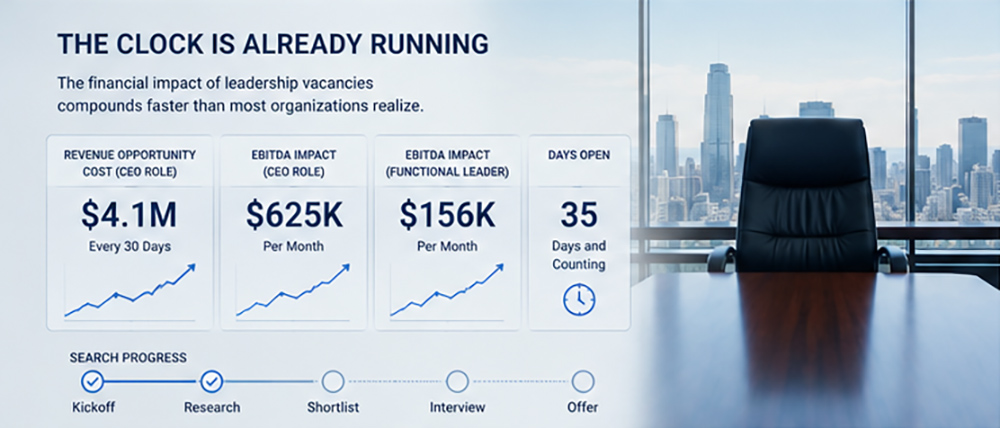
Before we talk about how we search, let’s talk about why speed is not just a preference — it is a financial imperative.
Consider a company with $500 million in revenue generating $75 million in Earnings Before Interest, Taxes, Depreciation, and Amortization (EBITDA). Every day an executive seat sits open or is occupied by an underperformer; it carries a measurable cost. It’s reasonable to expect a high-performing CEO to have a 10% impact on the top and the bottom line, per year. With that in mind for a CEO role, the opportunity cost reaches $4.1 million in revenue every 30 days — and $625,000 per month in EBITDA impact if that role is underperforming. Taking that same line of math using 2.5% impact at the functional leader level, a 2.5% drag on EBITDA translates to $156,000 per month in lost impact, compounding to nearly $1.9 million over the course of a year.
Now add in our own firms KPI’s: Currently, it takes the firm 38.1 days on average to introduce a client to its next executive leader. 80% of the time we do it in 24.5 days. 97 days total time, end to end. Our engagement completion rate is 97.5%. Our candidate stick rate after one year is 94.3%.
These are not hypothetical numbers. They reflect what is actually at stake when a ‘relationship’ and/or retained search firm off limits overrides urgency and quality. They don’t respect or are hamstrung to the opportunity cost of an open or underperforming leadership role.
As former operators, we deeply connect to this challenge. This is why speed AND quality assurance are not byproducts of how we work – it’s the center point of our ethos.
One more foundational comment before getting into the role of AI….
The Market Was Already Commoditized
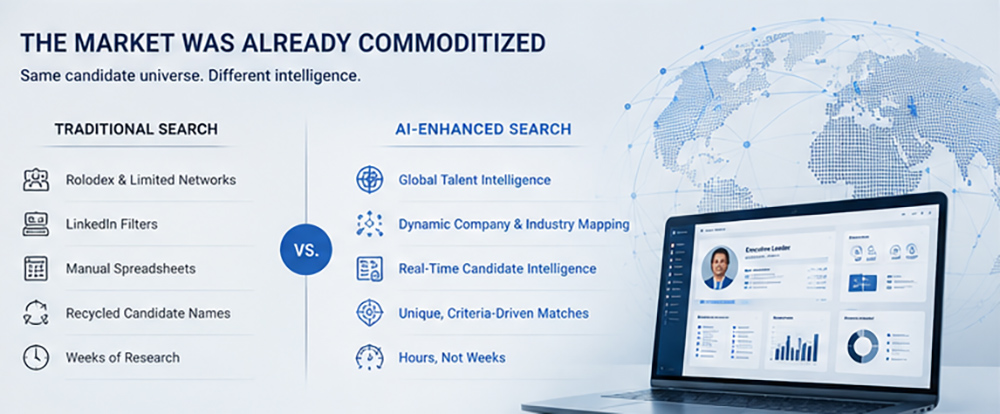
Let me be direct about something I have believed for years: LinkedIn commoditized the executive candidate market a long time ago – 10+ years ago. When every firm has access to the same global universe of executive names, the same filters, the same communication channels (email, InMail, mobile channels) — differentiation disappears. You are left hoping that your search partner has capacity, motivation, and works harder than the next firm. But the truth is, most clients still lean on the historical yardsticks – convenience of a legacy relationship, quid pro quo relationships and/or the quantity of searches in a particular sector or function for assurances speed and quality will follow.
That was already a thin proposition. Why don’t search firms publish speed and retention rates of all their placed candidates?
Today, with the emergence of AI, the situation has intensified dramatically. Exponentially commoditized. The candidate market is more commoditized than ever. But here is where the story turns: in the right hands, AI does not merely replicate the old game at higher speed. It creates the conditions for quantum improvement — in both the speed and the quality of outcomes. And the human factor — a consultant’s interview of a candidate — will bring even greater value in the future working in conjunction with AI.
The question – Who is built for this moment, and when?
We Did Not Wait
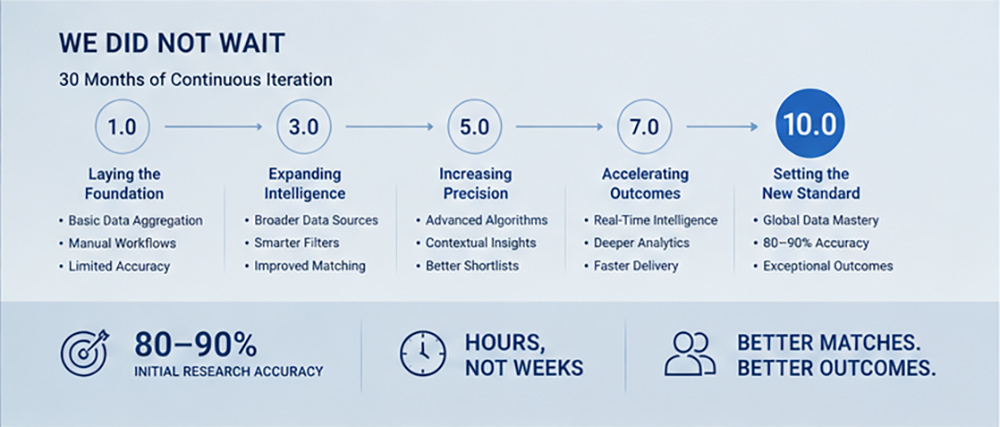
Thirty months ago, when virtually no retained search firm was meaningfully using AI, Carpe Diem started designing then deployed our own proprietary AI platform — built specifically for the demands of executive retained search, the wonky identification of candidates and accessibility to the necessary data. Not an off-the-shelf tool. Not a bolt-on feature. A purpose-built system, designed from the ground up around how great search actually works — with significantly higher efficacy than we were experiencing with off the shelf applications. I was saying internally the off-the-shelf applications were generating 40% accuracy of initial candidate research work 30 months ago. Today our proprietary AI application is 80-90% accurate right out of the gate. Saving massive time.
We are now on Carpe Diem AI version 10.0. I have never felt more excited about a technology as I do today.
Version10.0 is not a marketing number. That is the result of thirty months of continuous iteration, refinement, and real-world application across dozens of executive engagements. We built, we learned, tested, and we rebuilt. Every version made the platform smarter, faster, and more precise.
Where It Changes the Game
The greatest value we have realized falls into two categories, and both directly benefit our clients.
Research that is faster and more accurate.
The intelligence required to conduct a serious retained search — deep industry mapping, company analysis, organizational dynamics, and competitive landscape — used to take weeks. We now produce that work with dramatically greater speed and, critically, with greater accuracy in hours!
We are not cutting corners to go faster. We are eliminating the inefficiencies that are used to make thoroughness slow. The result is a research foundation that is both broader and deeper than what was previously achievable. The data was wonky when we started. It still is. But the effectiveness of our proprietary application is now much flatter.
AI Applications don’t improve off-limits, capacity issues, recycling inventory and/or using junior staff to recruit executives
And this is critical for you to remember — using an AI application on retained search firms’ own in-house data set is a heck of a lot easier than using it on a global set of internal and external data. Our application is designed for the global set (internal and external) of data. Why? Because not every candidate solution lies in our own data set! Every client has a unique set of criteria, we cater to a client’s criteria first, not coerce our in-house candidate relationships to force fit into a client’s key criteria.
Candidate intelligence gets to you faster through the use of AI.
Once a candidate enters our process, the volume of relevant data that must be gathered, synthesized, and contextualized is significant. Always has been. Our platform aggregates and summarizes that intelligence in a fraction of the time it once required. What used to be a labor-intensive process — one that delayed the delivery of meaningful candidate insights to our clients — is now streamlined. You receive richer information sooner. That said, we still require oversight and editing of the outputs of AI. On average, it gets us 80% of the way, but 20-30% requires human intervention of edits.
And given what we know from the discussion above, about the cost of open or underperforming seats, “sooner” has a dollar value that is very easy to calculate.
The Standard Is Rising
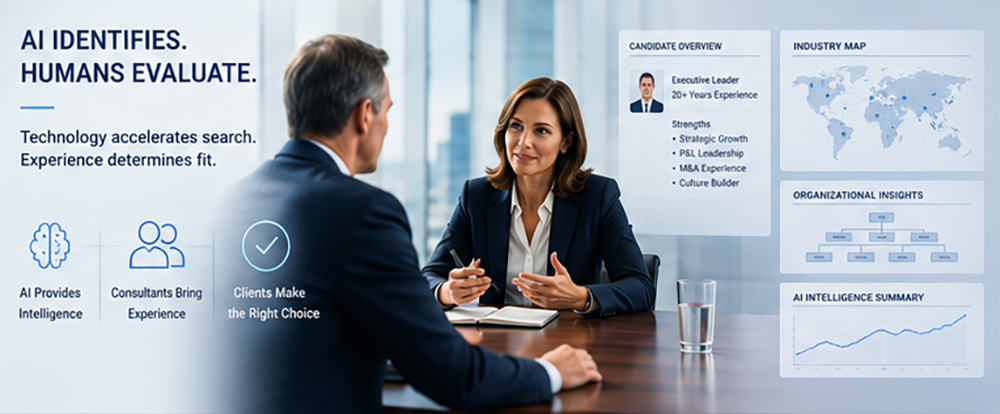
I will say plainly what is true: AI has arrived in retained search whether firms are ready or not. The firms that built early, iterated seriously, and embedded AI into their actual workflow for the external AND internal candidate pools — not just their pitch decks — will set the new standard.
The firms that built their AI application over top their own in-house data will always be limited to the very data in that insular pool. What good is faster candidate presentations that don’t meet a client’s criteria?
Interviewing executives by our consultants will not change. AI can’t probe on the various answers we hear from the questions we ask. It can’t read body language, eye contact, executive presence, or tone.
The firms that did not build their AI applications in the right areas will spend the next several years catching up.
We built it early. We have iterated seriously. And we are still building and iterating.
If you want to understand what a retained search looks like when it is powered by a platform that has been designed, tested, and refined over thirty months of real practice — let’s talk. Every day matters.
Together, we can seize the day.
— The Carpe Diem Global Partners Team